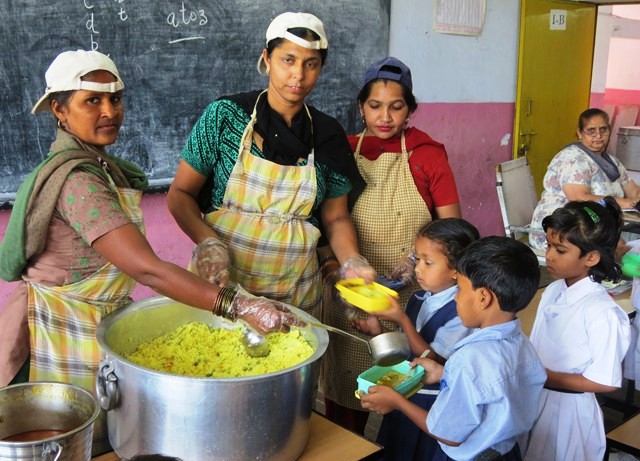
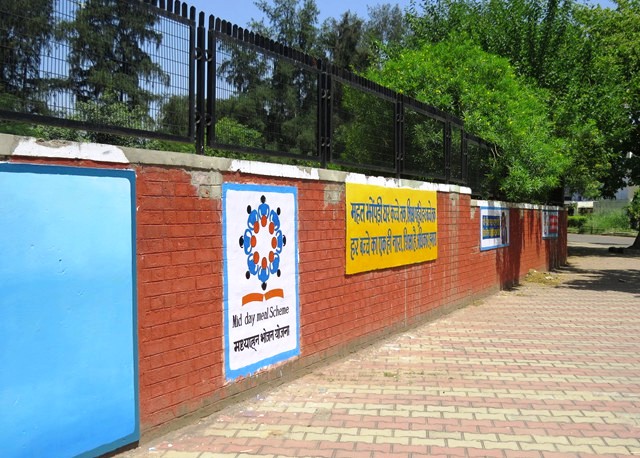
Mid Day Meal in schools has had a long history in India. In 1925, a Mid Day Meal Programme was introduced for disadvantaged children in Madras Municipal Corporation. By the mid 1980s three States viz. Gujarat, Kerala and Tamil Nadu and the UT of Pondicherry had universalized a cooked Mid Day Meal Programme with their own resources for children studying at the primary stage By 1990-91 the number of States implementing the mid day meal programme with their own resources on a universal or a large scale had increased to twelve states.
1. With a view to enhancing enrollment, retention and attendance and simultaneously improving nutritional levels among children, the National Programme of Nutritional Support to Primary Education (NP-NSPE) was launched as a Centrally Sponsored Scheme on 15th August 1995, initially in 2408 blocks in the country. By the year 1997-98 the NP-NSPE was introduced in all blocks of the country. It was further extended in 2002 to cover not only children in classes I -V of Government, Government aided and local body schools, but also children studying in EGS and AIE centres. Central Assistance under the scheme consisted of free supply of food grains @ 100 grams per child per school day, and subsidy for transportation of food grains up to a maximum of Rs 50 per quintal.
2. In September 2004 the scheme was revised to provide cooked mid day meal with 300 calories and 8-12 grams of protein to all children studying in classes I – V in Government and aided schools and EGS/ AIE centres. In addition to free supply of food grains, the revised scheme provided Central Assistance for (a) Cooking cost @ Re 1 per child per school day, (b) Transport subsidy was raised from the earlier maximum of Rs 50 per quintal to Rs. 100 per quintal for special category states, and Rs 75 per quintal for other states, (c) Management, monitoring and evaluation costs @ 2% of the cost of foodgrains, transport subsidy and cooking assistance, (d) Provision of mid day meal during summer vacation in drought affected areas.
3. In July 2006 the scheme was further revised to provide assistance for cooking cost at the rate of (a) Rs 1.80 per child/school day for States in the North Eastern Region, provided the NER States contribute Rs 0.20 per child/school day, and (b) Rs 1.50 per child/ school day for other States and UTs, provided that these States and UTs contribute Rs 0.50 per child/school day.
4. In October 2007, the scheme has been further revised to cover children in upper primary (classes VI to VIII) initially in 3479 Educationally Backwards Blocks (EBBs). Around 1.7 crore upper primary children were included by this expansion of the scheme. From 2008-09 i.e w.e.f 1st April, 2008, the programme covers all children studying in Government, Local Body and Government-aided primary and upper primary schools and the EGS/AIE centres including Madarsa and Maqtabs supported under SSA of all areas across the country. The calorific value of a mid-day meal at upper primary stage has been fixed at a minimum of 700 calories and 20 grams of protein by providing 150 grams of food grains (rice/wheat) per child/school day.
5.From the year 2009 onwards the following changes have been made to improve the implementation of the scheme:-
a) Food norms have been revised to ensure balanced and nutritious diet to children of upper primary group by increasing the quantity of pulses from 25 to 30 grams, vegetables from 65 to 75 grams and by decreasing the quantity of oil and fat from 10 grams to 7.5 grams.
b) Cooking cost (excluding the labour and administrative charges) has been revised from Rs.1.68 to to Rs. 2.50 for primary and from Rs. 2.20 to Rs. 3.75 for upper primary children from 1.12.2009 to facilitate serving meal to eligible children in prescribed quantity and of good quality .The cooking cost for primary is Rs. 2.69 per child per day and Rs. 4.03 for upper primary children from 1.4.2010.The cooking cost will be revised prior approval of competent authority by 7.5% every financial year from 1.4.2011.
c) The honorarium for cooks and helpers was paid from the labour and other administrative charges of Rs.0.40 per child per day provided under the cooking cost. In many cases the honorarium was so little that it became very difficult to engage manpower for cooking the meal. A Separate component for Payment of honorarium @ Rs.1000 per month per cook- cum-helper was introduced from 1.12.2009. Honorarium at the above prescribed rate is being paid to cook-cum-helper. However, in some of the states the honorarium to cook-cum-helpers are being paid more than Rs.1000/- through their state fund. Following norms for engagement of cook-cum-helper have been made:
- One cook- cum-helper for schools up to 25 students.
- Two cooks-cum-helpers for schools with 26 to 100 students.
- One additional cook-cum-helper for every addition of upto 100 students.
More than 25.70 lakhs cook-cum-helper are engaged by the State/UTs during 2013-14 for preparation and serving of Mid Day Meal to Children in Elementary Classes.
d) A common unit cost of construction of kitchen shed @ Rs.60,000 for the whole country was impractical and also inadequate .Now the cost of construction of kitchen-cum-store will be determined on the basis of plinth area norm and State Schedule of Rates. The Department of School Education and Literacy vide letter No.1-1/2009-Desk(MDM) dated 31.12.2009 had prescribed 20 sq.mt. plinth area for schools having upto 100 children. For every additional upto 100 children additional 4 sq.mt plinth area will be added. States/UTs have the flexibility to modify the Slab of 100 children depending upon the local condition.
e) Due to difficult geographical terrain of the Special category States the transportation cost @ Rs.1.25 per quintal was not adequate to meet the actual cost of transportation of foodgrains from the FCI godowns to schools in these States. On the request of the North Eastern States the transportation assistance in the 11 Special Category States (Northern Eastern States, Himachal Pradesh, Jammu & Kashmir and Uttarakhand) have been made at par with the Public Distribution System (PDS) rates prevalent in these States with effect from 1.12.2009.
f) The existing system of payment of cost of foodgrains to FCI from the Government of India is prone to delays and risk. Decentralization of payment of cost of foodgrains to the FCI at the district level from 1.4.2010 allowed officers at State and National levels to focus on detailed monitoring of the Scheme.
8.41 cr in Primary and 3.36 cr Upper Primary children i.e a total of 11.77 cr children were estimated to be benefited from MDM Scheme during 2009-10. 11.04 Crore children were covered under MDM Scheme during 2009-10. During 2010-11, 11.36 Cr children i.e 7.97 Cr. children in primary and 3.39 Cr. children in upper primary had been covered in 12.63 lakhs institutions. During 2011-12 total coverage of children against enrollment was 10.52 Crore (i.e. Prymary-7.71 crore and Upper Primary 3.36 crore children). During 2012-13, 10.68 Cr. children (Elementary level ) had been covered in 12.12 lakh Schools. 10.45 Cr. children were covered in 11.58 lakh Schools during 2013-14.